

Small dipping dishes make everyday meals feel more considered without asking you to reset the entire table. A little bowl of soy sauce, olive oil beside bread or a few olives at each place setting can be useful as well as inviting. The right set starts with what you serve, how many dishes you need at once and where they will live between meals. Choose those details first, then enjoy the color and pattern.
Start With Sauce, Condiments or Small Accompaniments
Write down the foods you expect to put in the dishes. Thin dipping sauces need an accessible surface for bread or another bite. Chunkier accompaniments need room for a spoon and enough depth to keep their contents contained. A small portion of olives asks for a different shape from a generous serving of dip for several people.
Decide whether you want one dish per person or several shared dishes. Individual portions sit near a place setting; shared portions need reachable space between diners. These uses can overlap, but choosing the main one keeps you from buying a set that looks attractive and leaves the practical job unfinished.
A dipping dish is not automatically a replacement for a snack bowl. Compare usable depth and capacity, especially if the photograph shows a small heap of food. A shallow dish may be ideal for a little sauce while providing too little room for the amount of nuts or salsa you normally serve.
Understand Diameter, Height and Usable Depth
Diameter describes the outside footprint of a round dish. Height usually describes the overall outside dimension. Neither necessarily tells you the depth inside, and thick walls or a raised base can change how much usable room remains. Read the listing carefully and ask for interior dimensions or capacity when those matter to your intended use.
For a practical scale example, a dish about 3.8 inches across occupies roughly the width of a small coaster-sized circle, though its exact footprint and rim profile vary. Place a paper circle of the listed diameter beside your dinner plate. You will see whether it fits comfortably without borrowing the space needed for a glass or cutlery.
Do not calculate a dish's capacity from its outer dimensions as though it were a straight cylinder. Curved sides, a sloping rim and ceramic thickness make that inaccurate. Use a stated capacity or plan around the foods and portion sizes shown with verified measurements. Lifestyle photographs are inspiration rather than a substitute for dimensions.
Choose Shallow or Deeper Shapes by How You Dip
A shallow, open shape makes it easy to reach a little sauce with bread or a dumpling. A deeper small bowl gives chunkier contents more room and can accommodate a spoon. The useful choice depends on both the food and the utensil. A very narrow opening may be inconvenient even when the capacity sounds sufficient.
Think about how the dish will be carried from the counter to the table. Leave space below the rim rather than filling it completely. A wide shallow dish of liquid needs a steady surface and careful movement; a deeper bowl still needs a stable base. Neither shape should be chosen on the assumption that it cannot spill.
For an everyday household, a consistent size across a set can simplify place settings. For varied shared serving, different depths may be useful, but only when the listing clearly identifies them. Confirm whether a mixed assortment varies in pattern alone or also in shape and size.
Work Out the Quantity Before Buying a Set
Count the dishes required for one ordinary meal. If four people each receive one dipping dish, you need four at the table. If you also want two shared condiments, that arrangement uses six. This simple count is more useful than choosing a larger set because it appears better value in isolation.
Allow for washing and storage without collecting more pieces than you can comfortably keep. A smaller household might use a six-piece set for several shared sauces, occasional guests and spare clean dishes. A larger set may suit more individual portions or two sauces per diner. These are planning examples, not a rule that every home needs a particular quantity.
When comparing sets, divide the current price by the number of dishes if the individual cost helps your decision. Then consider whether you will actually use the additional pieces. A lower price per dish is less meaningful if the extra dishes spend their time squeezed into a crowded drawer.
Confirm the Exact Assortment and What's Included
Look at the product variant and its corresponding photograph. A mixed set may include specific patterns rather than a choice of every design shown across the listing. Check the piece count, sizes and colors before ordering. If a styled scene contains serving boards, napkins or utensils, verify whether those accessories are included.
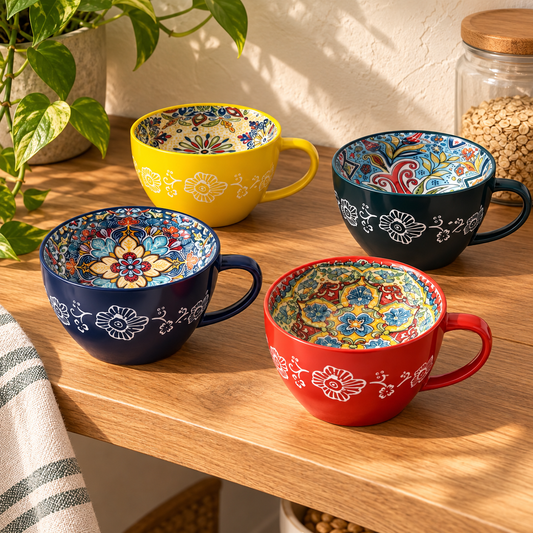
Zella Bohemian Ceramic Dipping Dish Set offers six-piece and ten-piece options. Its current listing states that each option includes the exact mixed assortment shown in its corresponding product photograph. Each dish is approximately 3.8 inches in diameter and 1 inch high. Those are exterior dimensions; do not interpret the height as a verified interior depth.
Zella's sets contain dishes only. The compact round, shallow shape suits individual sauces, condiments, olives and small accompaniments. Compare it with the portions you intend to serve rather than treating a set photograph as proof that it will hold a full snack serving for several people.
Plan Individual Settings and Shared Serving Space
For an individual setting, place the small dish where it can be reached without moving the drinking glass or crossing over another person's plate. You can test this with the dishes you already own and a paper footprint for the new set. Keep the actual table size in mind, especially on a narrow surface.
For shared serving, distribute dishes along the accessible area instead of gathering everything behind a centerpiece. Two small dishes placed at opposite ends of a table can be more convenient than one attractive cluster that some diners cannot reach. Keep room for the bread plate or main serving dish, too.
If you serve dishes on a board or tray, ensure their bases rest flat and that the board is suitable for the way you use it. A tray's decorative appearance does not establish food-contact suitability. Our decorative tray buying guide covers tray scale and placement; this guide focuses on the smaller food-serving vessels.
Pair Patterned Ceramics With Simple Supporting Pieces
Colorful dipping dishes can supply the table's most expressive detail. Plain dinner plates, quiet napkins and natural wood make that detail easy to appreciate. Repeat one color from the ceramics in a textile instead of adding several competing patterns. The result can feel coordinated while retaining the individuality of a mixed set.
If your plates are already patterned, choose small dishes that share a color or use a quieter finish. You do not need every item to match exactly. Look at the setting as a whole and keep enough clear surface around the dishes for ordinary use. A useful table arrangement should be easy to carry, serve and clear.
For wider decisions about table accents and room balance, see our dining room décor buying guide. Use that guide for the broader setting and this one for portion size, depth and quantity. Each purchase should solve a clear serving need.
Check Food Use and Product-Specific Care
Choose dishes explicitly intended for food service. A small ceramic trinket dish may look suitable for sauces, but appearance alone does not establish that use. Read the product description for food suitability and washing guidance. Decorative finishes and metallic details can have their own restrictions.
Zella's current description identifies its ceramic as food-safe and dishwasher-safe, and suitable for microwave use, steaming and baking. That guidance belongs to this product. It does not establish a universal care rule for patterned ceramics. If a listing does not provide temperature limits or detailed heating instructions, ask for them before planning a particular oven use.
Match care to your routine. A hand-wash-only set may be fine for occasional entertaining but less convenient for daily condiments. Check whether the interior is easy to rinse and whether a spoon fits without scraping awkwardly around the rim. Follow the maker's instructions and avoid making assumptions from another piece in the same color.
Check Storage and Stacking Before Adding More Pieces
Measure the drawer or shelf where the set will live. Diameter matters, but a stack's height also matters. Do not assume several dishes nest tightly from one side-view photograph. Look for stacking guidance or ask whether the rim and base are designed to sit together securely.
Keep stacks short enough to lift comfortably and protect delicate surfaces as directed. If pieces have textured exteriors or decorative rims, separators may be useful where the maker recommends them. Choose storage that lets you retrieve the dishes without unstacking an entire cupboard. Practical access makes a small set more likely to become part of ordinary meals.
If you use one dish for rings or desk accessories, keep that role distinct from your serving routine. Clean it according to the product instructions before returning it to food use. Multi-use styling can be appealing, but the most useful set still has a clear home and an easy care routine.
| Serving use | Shape to consider | What to verify |
|---|---|---|
| Thin dipping sauce | Shallow open dish | Usable depth and enough headroom |
| Chunky condiment | Deeper small bowl | Spoon access and stated capacity |
| Individual portions | One or more dishes per diner | Place-setting footprint |
| Shared sauces | Several reachable dishes | Space around plates and bread |
| Mixed set | Exact selected assortment | Count, patterns and accessories |
Your Final Dipping Dish Buying Checklist
- Identify sauces, condiments or small accompaniments you will serve.
- Decide between individual portions and shared dishes.
- Confirm outside diameter, height and any stated interior capacity.
- Choose shallow or deeper shapes around food and utensils.
- Count the dishes needed for an ordinary meal.
- Check the exact assortment and accessories included.
- Verify food suitability, washing and heating instructions.
- Measure storage space and confirm stacking guidance.
Avoid confusing overall height with usable depth, buying by set count alone or assuming every accessory in the photograph is included. Explore Urban Alcove's Kitchen collection and choose pieces that fit both your table and the meals you actually share.