

A favorite mug earns its place through small, daily pleasures: a comfortable handle, enough room for your usual drink and a shape that fits where you keep it. Color and pattern make that routine feel personal, but the best ceramic mug also works when the coffee machine is running, the cupboard is full and the washing-up needs doing. Start with your drink and your storage space, then choose the finish you love.
Start With Your Actual Coffee or Tea Routine
Before browsing, notice what you pour most often. A short coffee, a milky breakfast drink and a long cup of tea ask for different amounts of space. If you routinely add milk after pouring, count that extra volume. If you enjoy foam, leave room for it instead of choosing a mug that fits only the liquid beneath it.
Use a measuring jug to check the amount you normally drink. This is more useful than guessing from a photograph or buying the largest size available. You might discover that your everyday pour is comfortably smaller than the mugs you already own, or that your current cup leaves too little space to carry it without spilling.
Decide whether the mug will stay at a breakfast table, move between rooms or serve several purposes. A generous, bowl-like mug can suit a relaxed breakfast, while a more compact cup may be easier to carry and store. Neither shape is automatically better; choose around the routine you want to improve.
Compare Listed Capacity With Comfortable Filling Space
Capacity tells you how much a vessel can contain, but it does not always tell you how much you will comfortably drink from it. Some listings use a brimful measurement, while others describe a practical serving volume. Look for the measurement method and ask when it is unclear. A mug filled to its rim is different from one with room for milk, foam and movement.
For comparison, 8 US fluid ounces is about 237 milliliters, 12 is about 355 milliliters and 16 is about 473 milliliters. These are unit conversions, not universal mug categories. A listed 16-ounce mug should not be assumed to provide a comfortable 16-ounce serving with generous headroom unless the seller says so.
Think about how often you refill. One large pour can be appealing, but a smaller mug with a fresh refill may better suit someone who prefers a shorter drink. Choose the amount you actually enjoy rather than treating extra capacity as an automatic upgrade.
Choose Shape, Rim and Balance Together
A wide opening gives you a clear view of the drink and can make a mug useful for spoonable breakfasts. A taller, narrower shape has a different footprint and feel. Look at the entire silhouette: the width at the rim, the base underneath and the space added by the handle. Two mugs with similar capacities can occupy very different cupboard space.
Rim shape also affects how a mug feels to use. Close-up photographs can show whether it has a substantial rounded edge or a finer profile, although a picture cannot establish comfort for every person. If you already have a favorite mug, compare its proportions with the new option rather than choosing solely by color.
Check the empty weight when provided and remember that liquid adds weight. A sturdy-looking mug may feel quite different once filled. A broad base can be practical on a breakfast table, but it still needs a stable, uncluttered surface. Avoid balancing a mug partly on a napkin fold or the edge of a crowded tray.
Look Beyond the Handle's Appearance
An attractive handle needs usable clearance. Compare the space inside the loop, how far it sits from the body and the angle at which it joins the mug. A narrow opening may not suit your preferred grip, while a large handle can increase the overall width enough to affect storage.
Use your current favorite as a reference. Measure its handle opening and note whether you hold it with one finger, several fingers or a hand around the body. You do not need to prescribe one correct grip; you need enough information to choose a shape that suits yours. Ask for handle measurements if an online listing gives only capacity.
Do not assume a larger handle means the mug is lighter or easier for everyone to lift. Consider the full vessel, its contents and your own comfort. If buying a gift, a familiar everyday shape is often easier to choose confidently than a dramatic handle with no clear measurements.
Measure the Cupboard and Coffee-Machine Clearance
Record the mug's height, body diameter and total width including the handle. Then measure the shelf where it will stand. Leave enough clearance to lift it out without tipping it against the shelf above. Turning handles inward may save space, but the arrangement should still let you reach individual mugs comfortably.
For a coffee machine, measure the usable space beneath the outlet with the drip tray in its normal position. Check both height and width; an oversized mug may fit under the outlet but sit awkwardly on the tray. Follow the machine's instructions rather than assuming removing parts is an appropriate solution.
If you use hooks or a rack, check hook size, spacing and the rack's stated load limit. A wide mug can collide with neighboring pieces even when its handle fits. Only stack mugs when their construction and the maker's guidance support it. Upright storage is a useful default when stackability is unspecified.
Compare Ceramic Materials Without Making Assumptions
Ceramic is a broad description. Porcelain, stoneware and other ceramic bodies can have different appearances and constructions, but the material name alone does not confirm weight, durability, dishwasher suitability or microwave use. Read the information for the specific mug, including its glaze, decoration and any metallic details.
The most useful comparison is between actual products. Does the listing identify the material? Does it provide dimensions and capacity? Are washing and heating instructions clear? These answers tell you more about everyday suitability than a general claim that one ceramic type is always superior.
If a decorative finish is important to you, inspect close-up photographs of the exterior and interior. Remember that lighting and screens can shift color. Choose a mug explicitly intended for drinking, and follow the maker's instructions for its intended use. Decorative vessels and drinkware should not be treated as interchangeable just because both are ceramic.
Choose a Single Mug or a Set You Will Use
Count the people using mugs regularly and consider what happens while some are being washed. A single favorite can be enough for one daily ritual. A small set can cover guests or give a household a little breathing room between washing cycles. Buy around real use and available storage rather than a perfectly filled display shelf.
Check whether a listing is for one mug, a mixed assortment or a matching set. Look at the variant you are selecting: a photograph showing several colors does not necessarily mean they all come with a single purchase. Confirm the number of pieces and which designs are included before checkout.
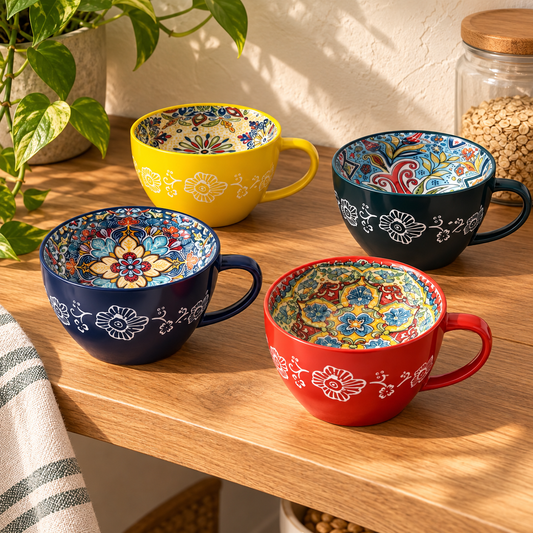
For example, Fiora Oversized Boho Porcelain Mug is listed with a generous 16+ ounce capacity and four distinctive designs, sold individually or as a four-mug set. Its wide handled shape also suits small portions of oatmeal, rice or soup. Compare that generous format with your cupboard and preferred serving size.
Coordinate Color Without Replacing Everything
A patterned mug can supply the accent color for a coffee corner. Repeat one small color in a napkin or nearby ceramic piece and leave the surrounding surfaces simple. Warm wood and plain ivory textiles give colorful interiors and floral details room to show. You do not need an exact matching set for the scene to feel considered.
Alternatively, keep mugs within a quieter color family and let their shapes differ. Cream, muted olive and clay can sit comfortably together when the shelf is tidy and the number of displayed pieces is restrained. The practical goal is a coffee area that is easy to use, with the pieces you reach for close at hand.
For broader placement ideas, read our kitchen décor buying guide. For choosing colors around objects you already own, use our room color palette guide. Keep the mug purchase focused on a useful daily vessel.
Read Care Instructions Before Checkout
Check the specific washing and heating guidance before buying. Microwave suitability and dishwasher suitability are separate questions, and neither follows automatically from a ceramic appearance. Metallic decoration and special finishes may have their own restrictions. Follow the product instructions rather than applying another brand's care advice to every mug.
Fiora's current listing states microwave suitability and top-rack dishwasher safety. That is guidance for Fiora, not a claim about every ceramic mug. If a different product requires hand washing, consider whether that fits your routine before choosing it for everyday use. A beautiful mug is more likely to stay in use when caring for it feels manageable.
Choose a shape you can clean inside and around the handle. Let washing and drying follow the maker's directions, and inspect pieces for damage during ordinary use. Avoid promising stain-proof finishes or special heat retention when a listing does not establish those properties. Clear information is part of a good buying decision.
| Buying decision | Compare | Practical check |
|---|---|---|
| Capacity | Listed volume and your usual pour | Leave headroom for milk or foam |
| Shape | Wide bowl-like versus taller format | Check total width and rim preference |
| Handle | Opening and distance from body | Compare with your favorite grip |
| Storage | Cupboard, machine or rack | Measure height and handle width |
| Care | Specific product instructions | Check washing and microwave use separately |
Your Final Ceramic Mug Buying Checklist
- Measure your usual drink, including milk or foam.
- Confirm listed capacity and whether it is brimful or usable volume.
- Compare rim shape, handle clearance and empty weight when available.
- Measure height, body width and total width with the handle.
- Check cupboard, machine and rack fit.
- Verify individual versus set quantities and selected designs.
- Read the specific washing and microwave instructions.
- Choose a color or pattern that adds to the pieces you already use.
Avoid buying by capacity alone, assuming every mug is stackable or overlooking the space taken by its handle. A good purchase combines practical fit with a finish you enjoy seeing each day. Explore Urban Alcove's Kitchen collection and compare the stated details before choosing your next everyday mug.