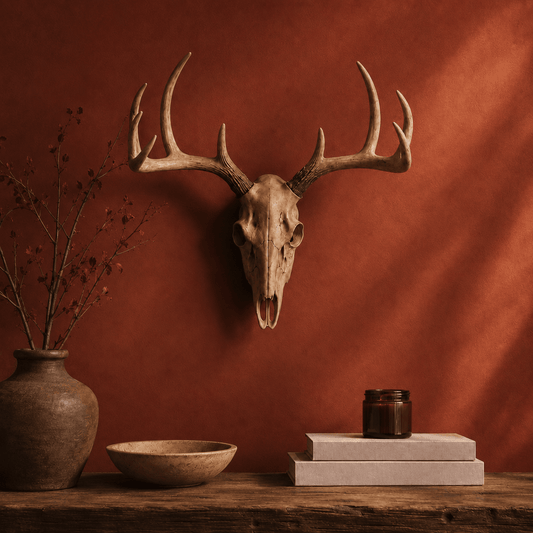
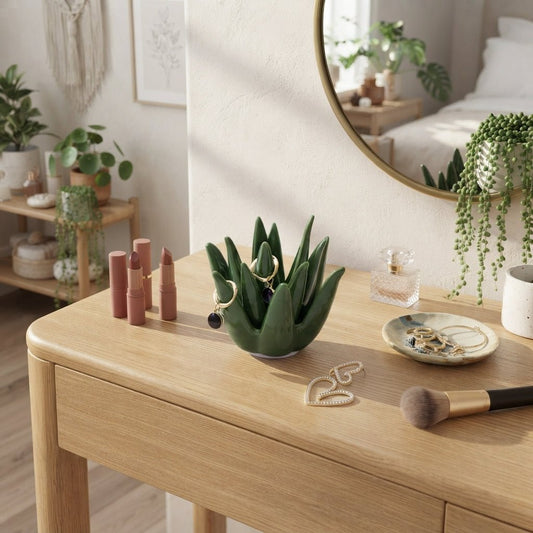
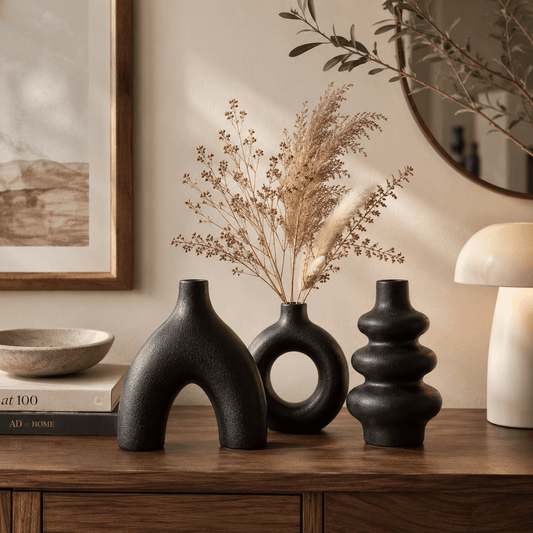
Decorative accents give a room personality, but they are most effective when they have a clear relationship to the surface, furniture, and materials around them. This guide explains how to measure, compare, group, and edit accents so they add character without creating clutter.
Decide What the Surface Needs
Before choosing an object, identify the role it should play. A console may need one focal piece to create height. A coffee table may need a low, contained arrangement that leaves room for drinks. A shelf may need contrast in shape or material rather than another small object.
Photograph the surface straight on and from the room entrance. Empty areas become easier to see, and you can tell whether the space needs height, width, color, texture, or simply less visual activity.
Measure Scale and Clearance
Record the usable width, depth, and height, including clearance beneath shelves, mirrors, cabinets, and lamps. Compare these measurements with the product’s full dimensions. If a vase will hold stems, include the finished arrangement height.
Test the footprint. A very small accent can look lost on a broad console, while a deep sculpture may crowd a narrow shelf. Use paper templates or household objects of similar size to preview the footprint. Leave enough space to clean around the object and use the surface normally.
Build Balanced Groupings
Create a visual triangle by placing the tallest element off center and stepping down through medium and low forms. A tray or stack of books can connect small objects and establish a clear boundary for the arrangement.
Mix Materials With Intention
Ceramic, wood, metal, glass, stone-like finishes, and woven fibers can work together when they share a color, shape, or degree of warmth. Pairing only identical finishes can feel flat; combining too many unrelated finishes can feel restless.
Repeat one material elsewhere in the room, then let the accent introduce contrast. A glazed vase can brighten a matte wood console, while a woven or carved object can soften a room dominated by glass and metal.
Check Function and Material Limits
Decorative trays, bowls, and vessels are not automatically food-safe, waterproof, or suitable for fresh flowers. Confirm intended use and care instructions. Protect delicate furniture from rough bases, moisture, and metal finishes that may transfer or scratch.
In bathrooms and kitchens, consider humidity and splashes. Near windows, check whether direct sun could fade color or affect natural materials. Stability matters on narrow shelves and in homes with pets or children.
Style Without Creating Clutter
Give each surface one clear focal point and preserve visible open space.
Group small related objects instead of scattering them. Keep everyday items contained, and remove pieces that compete with the main arrangement.
Editing is part of styling. Rotate accents seasonally or move pieces between rooms rather than displaying everything at once. A surface should still be easy to dust, set something down on, and live with.
Common Accent-Buying Mistakes
- Buying attractive objects without measuring the surface.
- Choosing several pieces with the same height and visual weight.
- Using decorative vessels for water or food without checking suitability.
- Filling every gap on a shelf.
- Ignoring base texture, stability, sunlight, and moisture.
Final Buying Checklist
- Identify the surface’s missing role: height, texture, color, or focus.
- Measure width, depth, height, and clearance.
- Check the object’s full dimensions and base stability.
- Confirm intended use and care limitations.
- Repeat one connecting color, material, or shape.
- Vary height and visual weight in groups.
- Preserve useful open space.
Ready to compare options? Explore Urban Alcove’s decorative accents collection.