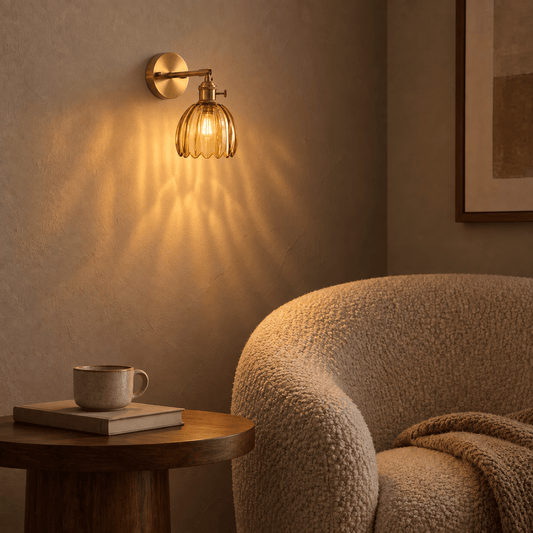
Good lighting is not simply about making a room brighter. It determines where your eye goes, whether reading feels comfortable, how colors and materials appear, and whether a room feels calm or harsh after sunset. The best lighting plans usually combine several modest light sources instead of asking one ceiling fixture to do every job.
This guide explains how to choose lighting for real rooms: which types you need, how large they should be, where to place them, what bulb specifications matter, and which common mistakes to avoid. Use it before shopping so you can compare fixtures by function as well as appearance.
Start With the Room, Not the Fixture
Before choosing a lamp or fixture, look at what actually happens in the room. A beautiful light can still be the wrong purchase if it does not illuminate the activities, surfaces, or corners that need attention.
Walk through the space at the times you use it most and make a quick lighting inventory:
- Identify the activities. Note where people read, work, prepare food, get dressed, dine, or relax.
- Mark the dark areas. Corners, shelves, worktops, and seating areas often remain dim even when the central ceiling light is on.
- Locate outlets. Check their distance from tables and seating, and decide whether visible cords will be acceptable.
- Notice natural light. A bright daytime room may still need several well-placed sources after sunset.
- Consider controls. Separate switches, dimmers, and portable lamps make it easier to change the atmosphere without over-lighting the entire room.
This simple survey helps you shop for a purpose. It also prevents the common habit of choosing one statement fixture first and trying to solve every other lighting need around it.
Use Three Layers of Lighting
A balanced room generally combines ambient, task, and accent lighting. Not every layer has to come from a separate category of fixture, but each job should be covered.
Ambient lighting
Ambient lighting provides the room's general illumination. Ceiling fixtures, pendants, chandeliers, recessed lights, and some floor lamps can all serve this role. The goal is comfortable visibility throughout the space—not maximum brightness.
Task lighting
Task lighting directs light where detailed activities take place. Examples include a table lamp beside a reading chair, a desk lamp, bedside lighting, under-cabinet kitchen lights, or a vanity sconce. It should reduce strain without shining directly into your eyes.
Accent lighting
Accent lighting adds depth and focus. A small lamp on a console, a wall light near artwork, or a softly glowing decorative fixture can draw attention to texture and create a gentler evening atmosphere. Accent lights do not need to illuminate the whole room to be effective.
Compare the Main Types of Home Lighting
| Lighting type | Best used for | What to check before buying |
|---|---|---|
| Table lamps | Reading, bedside use, consoles, soft ambient light | Total height, shade width, switch location, tabletop space, cord length |
| Floor lamps | Seating areas, dark corners, rooms with limited table space | Base footprint, stability, shade height, reach, clearance from walkways |
| Desk lamps | Focused work, studying, crafts | Adjustability, glare control, usable reach, brightness settings |
| Pendants | Dining tables, kitchen islands, entries, bedside lighting | Fixture diameter, hanging height, ceiling support, cord or rod adjustment |
| Wall sconces | Bedside use, hallways, mirrors, artwork, layered ambient light | Hardwired or plug-in installation, projection, mounting height, light direction |
| Portable or rechargeable lamps | Shelves, dining tables, patios when approved, outlet-free locations | Runtime, recharge time, charging method, brightness, indoor/outdoor rating |
| Decorative accent lights | Mood lighting, shelves, focal points | Light output, bulb availability, heat, placement stability |
Many fixtures can fill more than one role. A shaded floor lamp may provide ambient light while also supporting reading, and a pendant can be both a task light and a focal point. The deciding factor is where the light lands and whether the output suits the activity.
Choose the Right Scale and Placement
Measure before ordering. Lighting should feel proportionate to the furniture and open space around it. Product photos can make a lamp appear larger or smaller than it is, so compare the listed dimensions with measurements taken in your room.
Table and bedside lamps
Check the lamp's total height, shade width, and base width. The shade should not extend awkwardly beyond the table, and the base should leave room for everyday items. Beside a sofa or bed, the bottom of the shade should sit around seated eye level. This keeps the bulb out of direct view while allowing light to reach a book or nearby surface.
For many beds, a lamp approximately 24 to 30 inches tall works as a starting range, but mattress height, nightstand height, and the reader's position matter more than the number alone. Measure from the floor to the top of the nightstand, then compare that with the height of the mattress and headboard.
Floor lamps
Place a floor lamp close enough to the chair or sofa to illuminate the task without forcing people to lean toward it. Check the base footprint with painter's tape before buying, particularly beside compact seating. Keep the base and cord outside the natural walking path.
Dining and island pendants
A common starting point is to hang the bottom of a dining pendant about 30 to 36 inches above the tabletop. The fixture should illuminate the surface without blocking sightlines across the table. Kitchen-island pendants often begin in a similar range, but ceiling height, fixture size, and the height of household members may require adjustment.
For multiple pendants, plan the arrangement around the usable surface rather than spacing them evenly across the entire room. Leave enough distance between shades for each fixture to read clearly without creating dark gaps.
Wall lights
Many sconces are mounted with their centers roughly 60 to 66 inches above the floor, but this is only a reference point. Bedside sconces should relate to the mattress and reading position, while vanity lights must work with the mirror and the user's face. Always account for how far the fixture projects from the wall and whether doors, cabinets, or people can pass safely.
Understand Brightness, Color Temperature, and Bulbs
Fixture style is only half of the decision. The bulb determines much of the brightness, color, and comfort you experience.
Lumens: how much light you receive
Lumens measure brightness. For a gentle accent light, a few hundred lumens may be enough. A reading lamp often benefits from roughly 450 to 800 lumens directed toward the page. Larger rooms need more total light, but that output can be divided among several fixtures instead of coming from one intense bulb.
Dark paint, deep lampshades, and fixtures that direct light downward absorb or concentrate more of the output. Pale walls, open shades, mirrors, and reflective surfaces distribute light more readily. When in doubt, choose a dimmable solution within the fixture's supported range.
Kelvin: whether the light appears warm or cool
- 2200K–2700K: very warm to warm white; inviting for bedrooms, living rooms, and evening atmosphere.
- 3000K: warm but clearer; versatile for kitchens, bathrooms, and modern interiors.
- 3500K–4000K: neutral to cool white; useful for detailed tasks, though it may feel stark in relaxation spaces.
- 5000K and above: daylight-like light generally reserved for highly functional or specialized tasks.
Keeping color temperatures reasonably consistent within one sightline makes a room feel intentional. If a living room opens into a kitchen, for example, 2700K in the seating area and 3000K over work surfaces can coexist more comfortably than an abrupt shift from very warm to blue-white light.
CRI and bulb compatibility
The Color Rendering Index indicates how naturally colors appear under a light source. A CRI of 80 or higher is suitable for everyday use; 90 or higher is helpful where accurate color matters, such as vanities, artwork, textiles, or food preparation.
Before ordering, confirm the socket type, maximum wattage, bulb shape, and whether the fixture includes an integrated LED. If you want dimming, both the fixture and bulb must support it, and hardwired fixtures may also require a compatible wall dimmer.
Plan Lighting Room by Room
Living room
Combine general illumination with lamps near the main seating areas. A floor or table lamp beside a reading chair provides useful task light, while a smaller accent light can soften a console or dark corner. Use separate controls so the room can shift from active daytime use to a calmer evening setting.
Bedroom
Prioritize warm, low-glare light. Bedside lamps or sconces should be reachable from the bed and positioned so the bulb is not visible when reclining. Add a brighter source near wardrobes or dressing areas rather than making the bedside lighting perform both jobs.
Kitchen
General ceiling lighting rarely eliminates shadows beneath upper cabinets or over preparation surfaces. Add focused task lighting where food is chopped, washed, and cooked. Pendants can support an island, but they should not be the only source in the room.
Dining room
Center the primary fixture over the table—not necessarily the center of the room. A dimmer is especially useful because dining areas move between meals, homework, entertaining, and evening ambiance. A lamp on a nearby sideboard can make the room feel more layered and intimate.
Bathroom
Face-level lighting around a mirror is often more flattering and functional than relying only on a ceiling fixture. Confirm that every fixture is rated for the intended damp or wet location and that installation follows applicable electrical requirements.
Home office
Use a desk lamp to illuminate the work surface without reflecting into a screen. Position the light opposite your writing hand to reduce shadows. Balance the focused lamp with softer ambient illumination so the screen is not the brightest object in a dark room.
Coordinate Lighting Without Matching Everything
A coordinated room does not require identical lamps. Repetition creates cohesion more naturally than exact matching. Choose one or two elements to carry through the space:
- a warm brass, black, wood, or ceramic finish;
- rounded or angular silhouettes;
- woven, frosted glass, or fabric shade textures;
- a consistent bulb color temperature;
- similar visual weight, even when fixture sizes differ.
Modern-organic rooms often benefit from warm light, tactile materials, and softly curved forms. Nordic-inspired spaces may favor simpler silhouettes and pale finishes, while boho rooms can accommodate more woven texture and sculptural detail. Let the fixture support the room's character, but do not sacrifice scale or function for style alone.
Choose Between Plug-In and Rechargeable Lighting
Plug-in fixtures are usually the best choice for dependable daily lighting. They can operate continuously and offer a wider range of brightness. Check cord length and outlet placement, especially when the fixture will sit on a floating shelf or central table.
Rechargeable lamps are useful where a cord would be inconvenient, including dining tables, shelves, and flexible accent locations. Compare battery runtime at the brightness level you expect to use—not only the longest advertised runtime, which may be measured at the lowest setting. Also check recharge time, charging port, replacement options, and whether the lamp remembers its last brightness setting.
Do not assume a portable lamp is suitable outdoors or in a bathroom. Use it in damp or exposed areas only when the product carries an appropriate rating.
Lighting Buying Checklist
- What job will this fixture perform: ambient, task, accent, or more than one?
- What are the exact height, width, shade, base, and projection measurements?
- Will it fit the surface while leaving usable space?
- Where will the light land when someone is seated, standing, or working?
- Is the bulb included, replaceable, dimmable, or integrated?
- What socket, bulb shape, maximum wattage, lumens, and Kelvin range are supported?
- Is the cord long enough, and can it be routed safely?
- For rechargeable lighting, what is the realistic runtime and recharge method?
- For hardwired lighting, is the mounting hardware suitable and will professional installation be needed?
- Is the fixture rated for the room's moisture or outdoor conditions?
Common Lighting Mistakes to Avoid
- Relying on one ceiling light. This often creates glare above and shadows where activities actually happen.
- Choosing by appearance alone. A beautiful lamp may be too short, too dim, or too wide for its intended location.
- Exposing the bulb at eye level. Check shade height and viewing angles from seated and standing positions.
- Mixing drastically different bulb colors. Warm and blue-white sources in the same room can make the lighting feel disconnected.
- Ignoring switches and cords. A hard-to-reach control or visible cord across a walkway quickly becomes frustrating.
- Over-lighting every surface. Some contrast is desirable. Softer areas give the room depth and allow focal points to stand out.
- Skipping installation requirements. Weight, wall construction, ceiling support, moisture ratings, and electrical work should be confirmed before purchase.
Build a Lighting Plan That Can Adapt
Build for flexibility. The most successful lighting plans are flexible. Start by solving the room's essential tasks, then add warmth and character with a second or third source. Measure before ordering, compare light output as carefully as fixture dimensions, and choose controls that let the room change throughout the day.
When you are ready to compare styles, explore Urban Alcove's decorative lighting collection for table lamps, wall lights, pendants, and portable accent lighting selected for warm, inviting interiors.