Decorative Accents Buying Guide

How to Choose Decorative Accents That Feel Collected

Decorative accents give a room its personality, but the strongest arrangements balance character with restraint. Use these four considerations to choose pieces that suit your surfaces, complement what you already own, and make the room feel intentionally finished.

01

Begin with the surface and its purpose

Think about where the accent will live and what else the surface needs to hold. A console can support a taller vase or sculpture, while a nightstand or bathroom counter usually needs a smaller piece that leaves room for everyday essentials. Functional accents such as trays can add style while keeping small items contained.

02

Choose a scale that feels balanced

Small accents can disappear on a wide table, while an oversized piece can overwhelm a narrow shelf. Compare the product dimensions with the available surface and the furniture around it. For grouped arrangements, vary the heights but keep the overall composition comfortably within the width of the surface.

03

Mix shape, texture, and material

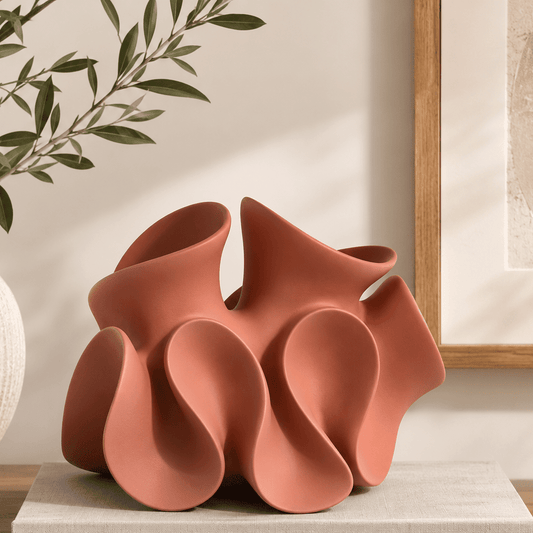
A collected arrangement is more interesting when every piece is not identical. Pair a curved ceramic vase with a lower tray, a sculptural form, or a natural wood detail. Repeat one color or material elsewhere in the room so the grouping feels connected rather than random.

04

Leave room for each piece to breathe

Negative space is part of the arrangement. Start with one focal piece, add one or two supporting accents, then step back before adding more. Leaving some of the tabletop or shelf visible makes the display easier to appreciate and helps the room feel calm instead of crowded.

Read The Art of the Accent

Warm modern organic console styled with ceramic vases, an abstract sculpture, books, and a decorative tray

Frequently Asked Questions

There is no fixed number, but one focal piece or a group of three often works well on a console, shelf, or coffee table. Vary the height and shape of grouped pieces, and leave enough open space for the surface to remain useful and visually calm.

Check the listed dimensions against both the surface and nearby furniture. Taller pieces can anchor a console or open shelf, while compact accents are better suited to nightstands, vanities, and smaller ledges. Also consider the full height if you plan to add stems or branches to a vase.

No. A room usually feels more natural when accents are coordinated rather than identical. Repeat one element—such as a warm neutral color, rounded shape, ceramic finish, or wood tone—while allowing the pieces to differ in scale and form.

Yes, when the product details suit your intended use. Decorative trays can gather jewelry, keys, toiletries, or small tabletop objects while making the arrangement feel intentional. Review the listed material, dimensions, and care instructions before using a tray near water or with food.

Choose fewer pieces with distinct shapes or textures, group related items together, and preserve open space around them. Using trays to contain small objects and rotating seasonal or favorite accents instead of displaying everything at once also helps the room stay edited.

Ideas & Inspiration